
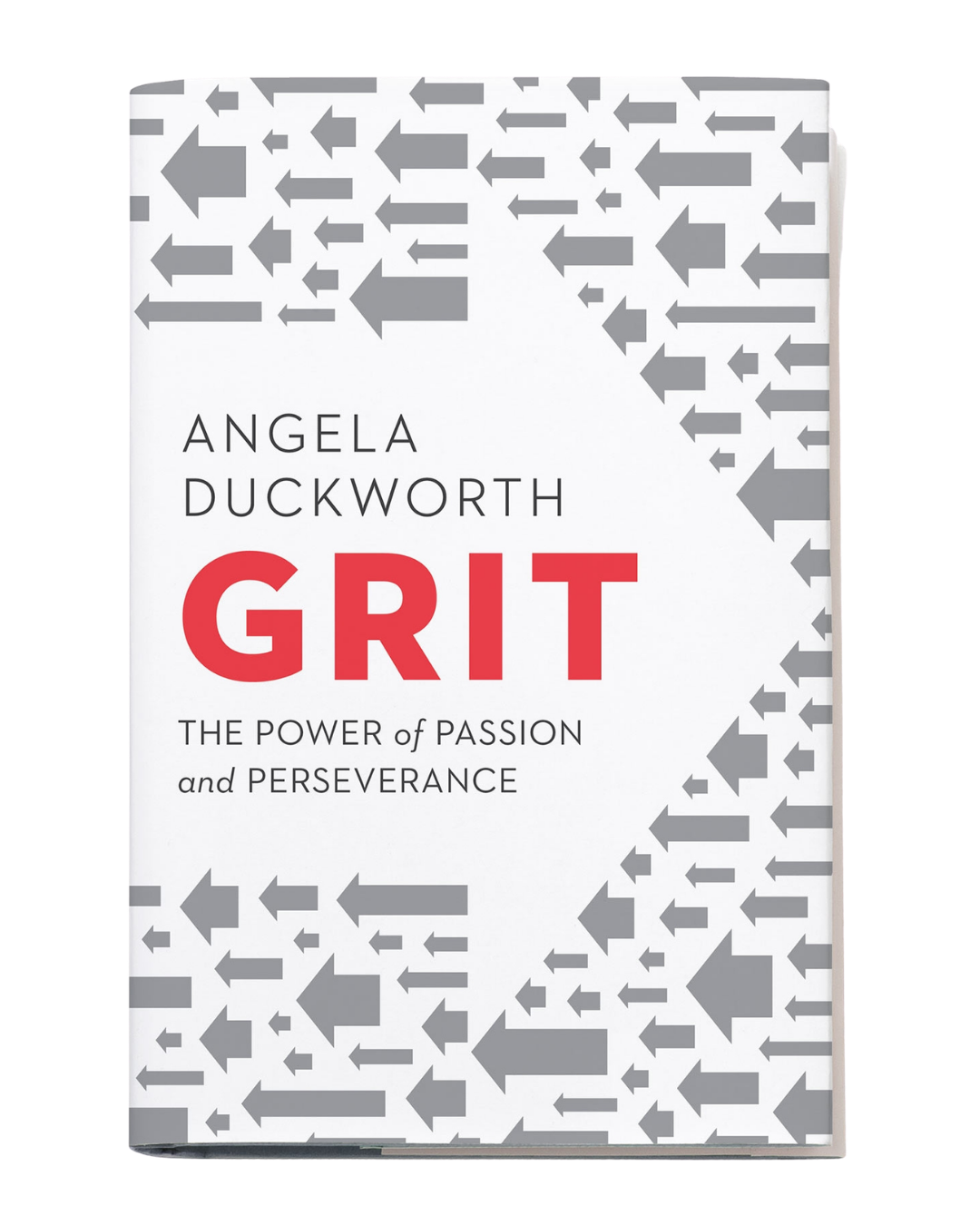


ABOUT THE BOOK
In this instant New York Times bestseller, pioneering psychologist Angela Duckworth shows anyone striving to succeed—be it parents, students, educators, athletes, or business people—that the secret to outstanding achievement is not talent but a special blend of passion and persistence she calls "grit."
Why do some people succeed and others fail? Sharing new insights from her landmark research, Angela explains why talent is hardly a guarantor of success.
Angela has found that grit—a combination of passion and perseverance for a singularly important goal—is the hallmark of high achievers in every domain. She's also found scientific evidence that grit can grow.
Angela gives a first-person account of her research with teachers working in some of the toughest schools, cadets struggling through their first days at West Point, and young finalists in the National Spelling Bee. She also mines fascinating insights from history and shows what can be gleaned from modern experiments in peak performance. Finally, she shares what she's learned from interviewing dozens of high achievers—from JP Morgan Chase CEO Jamie Dimon to Seattle Seahawks Coach Pete Carroll.
Winningly personal, insightful, and even life-changing, Grit is a book about what goes through your head when you fall down, and how that—not talent or luck—makes all the difference.
as seen in









TED Talk on Grit
Leaving a high-flying job in consulting, Angela Lee Duckworth took a job teaching math to seventh graders in a New York public school. She quickly realized that IQ wasn’t the only thing separating the successful students from those who struggled. Here, she explains her theory of “grit” as a predictor of success.
Grit hub
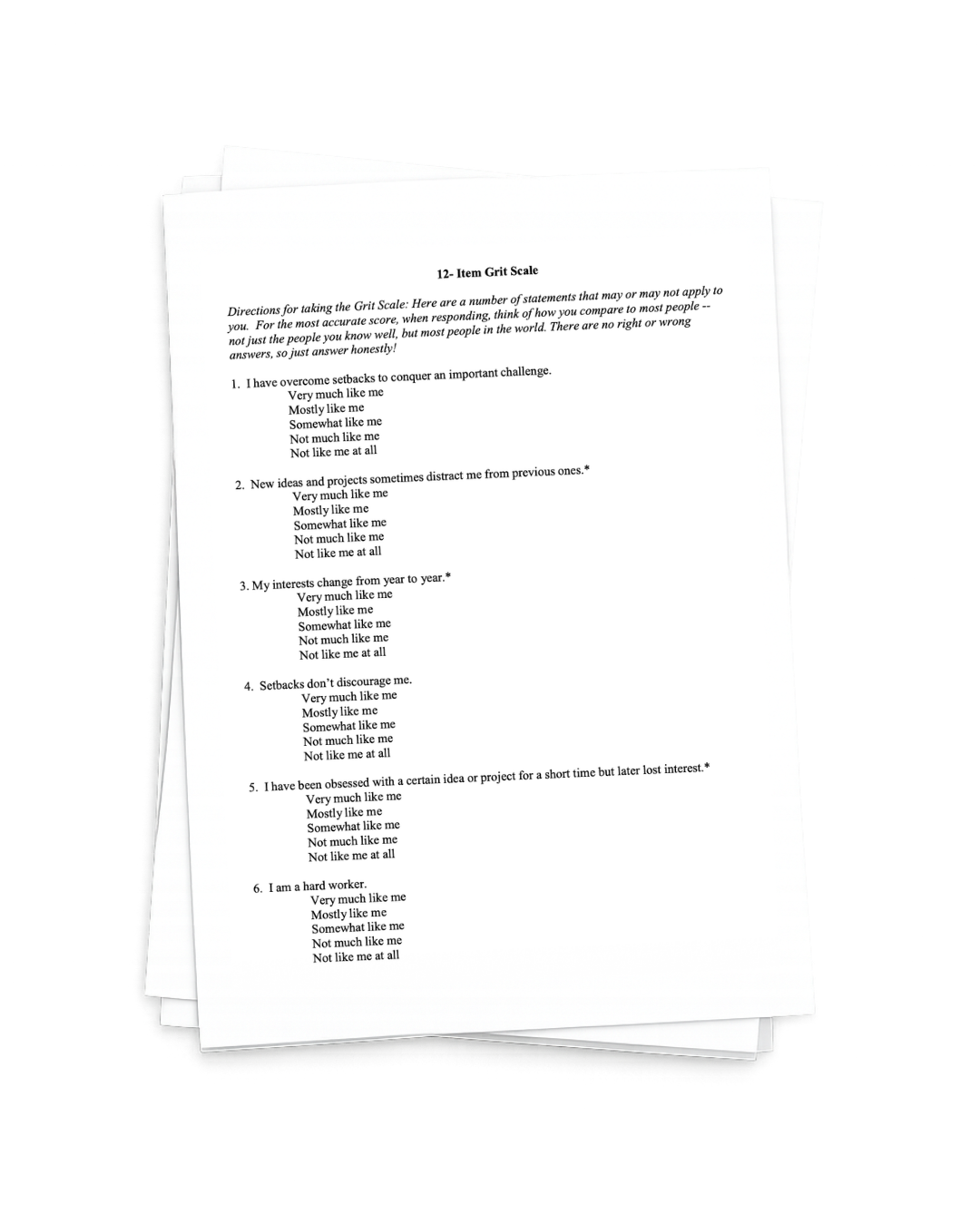
10-ITEM GRIT SCALE
GOAL HIERARCHY

GRIT PLAYBOOK
How gritty am I?
I created the Grit Scale by interviewing world-class achievers across domains and distilling their common observations about what makes them—and the performers they most admire—successful.
Created for the purpose of scientific research, the Grit Scale is also useful as a prompt for self-reflection. Some of the most effective coaches and teachers give it to their players and students to spark a conversation about evolving passion and perseverance.
Permissions: There are no restrictions for non-commercial uses for research, translation, or education. However, copyright protections prohibit reproduction in books, magazines, or other outlets, and/or commercial use. The only validated English-language versions endorsed are the 12-item (Duckworth et al., 2007) and 8-item (Duckworth & Quinn, 2009) scales.
A note on limitations: All psychological measures, including the Grit Scale, have limits. You can fake a higher score without much effort. There’s also a serious distortion called reference bias—people hold different standards by which they judge their own behavior, so a score reflects both how gritty someone is and the standards they hold themselves to.
The Grit Scale is appropriate for research and self-reflection. It is not appropriate for selecting employees, admitting students to college, gauging the performance of teachers, or comparing schools or countries to each other.
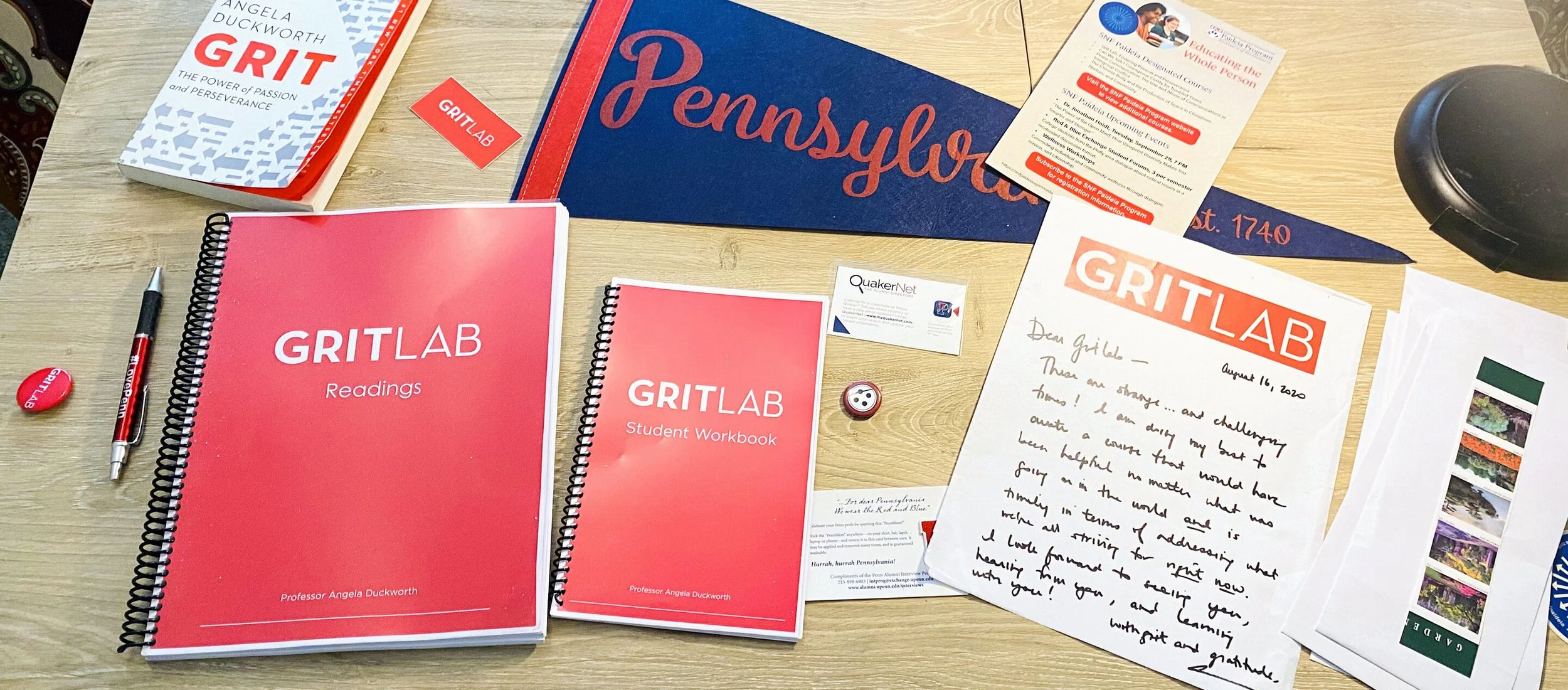
GRIT LAB 101
A free, research-backed 13-week course that helps high school students build the mindsets and skills to pursue their long-term goals. A randomized controlled trial found large gains in students’ course-related knowledge and metacognitive skills.
Frequently Asked Questions
-
Grit is passion and perseverance for long-term goals.
One way to think about grit is to consider what grit isn't. Grit isn't talent. Grit isn't luck. Grit isn't how intensely, for the moment, you want something.
Instead, grit is about having what some researchers call an "ultimate concern"—a goal you care about so much that it organizes and gives meaning to almost everything you do. And grit is holding steadfast to that goal. Even when you fall down. Even when you screw up. Even when progress toward that goal is halting or slow.
Talent and luck matter to success. But talent and luck are no guarantee of grit. And in the very long run, I think grit may matter at least as much, if not more.
-
I created the Grit Scale so that I could study grit as a scientist. Why? Because you cannot study what you cannot measure.
I also think this questionnaire is useful as a prompt for self-reflection. For example, some of the most effective coaches and teachers I know give this questionnaire to their players and students in order to prompt a conversation about their evolving passion and perseverance.
However, all psychological measures, including the Grit Scale, have limitations. You can fake a higher grit score without much effort. Another serious but not-so-obvious limitation of questionnaires is "reference bias"—a distortion that comes from people holding different standards by which they judge behavior. Your score reflects both how gritty you are and the standards to which you hold yourself. I talk about this limitation in this article and this article.
The Grit Scale can be used for research and for self-reflection, but its limitations make it inappropriate for many other uses, including selecting employees, admitting students to college, gauging the performance of teachers, or comparing schools or countries to each other.
-
Not necessarily. To be gritty, in my view, is to have passion and perseverance about something in your life. This doesn't mean you necessarily engage in all possible pursuits with equivalent passion and perseverance. The limits of time and energy suggest that focusing on one thing means focusing less on others. You can't pursue becoming a great pianist and at the same time a great mathematician, and a great sprinter and chef and philosopher. But it's also true that to be gritty means to pursue something with consistency of interest and effort. Some people choose not to pursue anything in a committed way, and that, to me, is lack of grit.
-
Grit predicts achievement in really challenging and personally meaningful contexts. Graduating from high school or college rather than dropping out is one example. Returning to the National Spelling Bee with hopes of doing better than you did last year is another. But there are other goals for which enduring passion and perseverance are less relevant. Getting started on your taxes before April 15 takes self-control more than grit. Ditto for studying for a history test on Friday when you'd rather be on Instagram.
Here is an article that describes in more detail how grit and self-control differ, and another explaining how grit is really about sticking with what are called "superordinate goals."
Finally, here is an article about how standardized test scores are not the only way to assess what a student knows and can do. For the record, I believe grit will for many adolescents be more evident in activities pursued outside of the classroom—in the school play, on the football field, in the school orchestra, in community service. This is what educational psychologist Warren Willingham found in 1985, and it's also what I find in my more recent research.
-
Grit is related to two other characteristics: self-control and conscientiousness. Someone demonstrating high self-control or high conscientiousness is also likely to score high in grit. But are they so similar that they actually measure the same underlying personality trait? I don't think so. Grit predicts achieving challenging goals even when these other characteristics are held constant. Grit is a more reliable predictor of making it through the first, tough summer of West Point military training than either self-control or conscientiousness.
-
I don't have any data that suggests there are drawbacks to being extremely gritty. At the very top of the Grit Scale, I typically find individuals who are tremendously successful and also satisfied with their lives. However, this doesn't mean we should entirely dismiss the possibility of "too much grit."
In particular, you can be too stubborn about mid-level and low-level goals. You can throw good money after bad on particular projects that will never make sense. You can be blind to possibilities that you hadn't originally anticipated. Still, I think these problems are mostly about lower-level goals that are in service of your high-level goals—those abstract and enduring concerns I discuss in Chapter Four. For me, my very highest-level goal is to use psychological science to help kids thrive. That's my mission statement, and I can't think of anything that would make me give up on it.
-
In some samples, women score slightly higher on the Grit Scale than men. However, it's not always the case. The data aren't solid enough to claim that there is a reliable difference in grit between men and women.
-
The power of grit doesn’t mean circumstances are irrelevant to our success or failure I've spent a lot of my life in urban classrooms, both as a teacher and as a researcher. I know how much the expertise and care of the adult at the front of the room matter. And I know that a child who comes to school hungry, or scared, or without glasses to see the chalkboard, is not ready to learn. Grit alone is not going to save anyone.
But the importance of the situation is two-fold. It's not just that you need opportunity in order to benefit from grit. It's also that the situations our children grow up in profoundly influence their grit and every other aspect of their character.
Grit is necessary but not sufficient for achieving our potential. In addition to grit, we need a situation that challenges and supports us. We need personal space that makes wise choices obvious, easy, and rewarding. We need peers who share our interests and values. We need mentors. And we need to live and work in cultures where excellence is the norm.
The question is not whether we should concern ourselves with our inner grit or our outer circumstances. In the most profound sense, both are important, and more than that, they are intertwined.
-
When I say "talent," I mean specifically the rate at which a person improves in skill. So if you're a really talented basketball player, you improve very quickly when compared to less talented players with equivalent practice and opportunity. Like the award-winning actor and musician Will Smith, I think it's useful to distinguish between skill and talent. See Chapters Two and Three in Grit for a longer discussion.
-
If I had to choose between my daughters growing up honest or gritty, I'd choose honest. If I had to choose between kindness and grit, I'd choose kindness. Grit is only one aspect of character, and for me, personally, it's not the most important aspect.
Fortunately, I don't see any necessary trade-off between goodness and greatness. I am encouraging my girls to cultivate their interests and a sense of purpose, because I want them to have a passion that guides them for their entire lives. I am also helping them learn perseverance. With guidance, they are learning to practice hard things every day, and to interpret failure and adversity as necessities of learning. My ultimate hope is that they lead honest, kind, and gritty lives.
-
The nature versus nurture question is as old as time. Here's the answer from contemporary science: Yes, grit and everything else is influenced by genes. But grit and everything else is also influenced by experience. In Chapter 5, I lay out a simple argument for believing that grit can grow.
-
I can't tell you whether happiness or achievement is more important. That's a question of values, not science.
I can say that when you measure both, you find they tend to go together more than they split apart. While we can all think of someone who is happy but not successful, or successful but unhappy, these are exceptions. The grit paragons I've interviewed over the years are on the whole quite happy and successful. While I would not call them "carefree" or "laid back," I would say that they are tremendously satisfied with their lives—even if that includes never being satisfied with their level of skill or achievement. I myself think, daily, about what I could do better. And yet I'm happy.
-
The entire book is about teaching grit. Before I became a psychologist, I was a classroom teacher. It was as a teacher that I discovered how important psychology was to a child's achievement.
It's not an exaggeration to say that every chapter has special relevance to teachers. Chapters Two and Three might be especially useful when explaining the importance of effort (versus talent) to students. Chapters Six, Seven, Eight, and Nine on interest, practice, purpose, and hope are where I define the four psychological assets that lead to grit. In Chapter Nine, I talk about parenting for grit—but the same dynamics play out in the classroom. In Chapter Ten, I explain why Harvard and other colleges are eager to see students cultivate their grit in extracurricular activities. Finally, a teacher who wants the classroom culture to support grit will find Chapter Twelve full of examples of how to do that.
-
Parents and educators can access all of Character Lab's Playbooks and past Tips of the Week at characterlab.org.
-
There are no restrictions for non-commercial uses for research, translation, or education. However, copyright protections prohibit reproduction in books, magazines, or other outlets, and/or commercial use.
For research, please note that the only validated English-language versions endorsed are the 12-item version (Duckworth et al., 2007) and the 8-item version (Duckworth & Quinn, 2009). The 10-item version was published in the book Grit for the convenience of readers who wanted to calculate their scores by summing and dividing by 10. These scales are all extremely highly correlated (and are just subsets of the original 12-item scale), so if you've already collected data using the 10-item scale, you might point out this fact and cite this paper: Duckworth, A. L., Quinn, P. D., & Tsukayama, E. (2021). Revisiting the factor structure of grit: A commentary on Duckworth and Quinn (2009). Journal of Personality Assessment, 103(5), 573-575. doi.org/10.1080/00223891.2021.1942022.
For most research purposes, because it more fully represents the construct of grit, I recommend the 12-item version. I do not keep track of translations of the Grit Scale into languages other than English, but I am aware—and encouraged—that other researchers have done so.